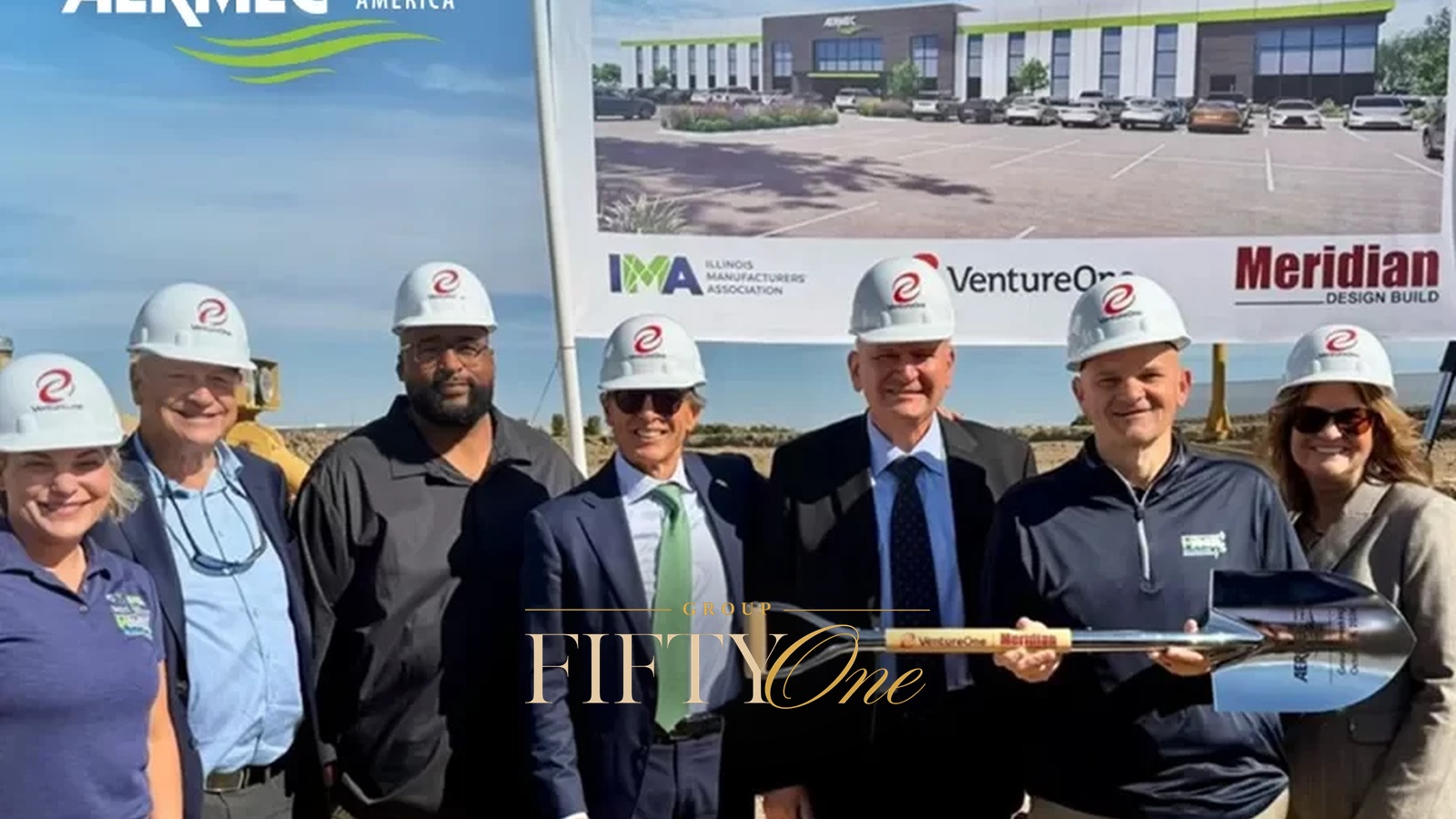
Aermec sold into the U.S. and Canada for more than twenty years before breaking ground on its first American manufacturing site on October 8. For a European company weighing its next move, that sequence is worth paying attention to. Customers came first. The plant came later.
The Italian HVAC company chose DeKalb, Illinois. The governor’s announcement describes a $15 million investment, a facility of more than 186,000 square feet and 30 new full-time jobs, supported by an Illinois EDGE agreement. There’s a discrepancy worth keeping visible: Aermec’s own announcement describes an investment exceeding $35 million. The two releases don’t explain the difference, so the $15 million figure here is the state’s stated figure, not a reconciled total project cost.
What matters for the market-entry conversation is the order of events. Aermec says it has served customers across the U.S. and Canada for more than twenty years. That’s a long time to learn what customers need, how they buy and what local service has to look like. An American plant follows an established commercial presence. It isn’t being asked to create one from scratch.
Not every company should wait two decades. And the public announcements don’t tell us how Aermec calculated the return on this investment. But the principle travels well: before you commit to a building, establish whether your customers, order pipeline and operating requirements justify being there. Selling into a market and manufacturing in it are different decisions. They don’t have to happen at the same time.
Then comes the question European executives often make too broad: where in America? In this case, the answer wasn’t simply the United States. It was DeKalb. Local officials highlighted I-88, rail access and the workforce connected to Northern Illinois University and Kishwaukee College. Those are specific advantages in a specific place, not a generic argument for choosing America.
This is what fifty markets looks like in practice. Your shortlist should reflect where customers are, how equipment and materials move, who can run the operation and which institutions can help train the next team. A state that works beautifully for one company may be the wrong answer for another. The incentive belongs in that comparison, but it shouldn’t replace it.
The scale is worth noticing too. Thirty announced jobs earned a governor’s announcement and an EDGE agreement. European executives sometimes assume state support is reserved for projects with thousands of employees. This announcement shows that a smaller headcount can still matter to a state and its local partners. It doesn’t mean every 30-job project qualifies, or that support comes without eligibility rules and commitments.
If you’re a mid-sized European company, don’t rule yourself out before having the conversation. Bring a credible investment plan, realistic hiring numbers and a clear explanation of what your business needs. Ask which programs fit, what you’ll have to deliver and how those obligations affect the economics. An incentive is useful only if the underlying location works.
DeKalb also offers a useful bridge to the hiring question. The colleges weren’t an afterthought in the local account of the decision. They were part of the reason the location made sense. A manufacturing project needs a customer base and a place to operate, but it also needs people who can turn the machinery into production.
The takeaway is straightforward: prove the commercial case, compare places on the needs of your business, and talk to local partners before you assume your project is too small. You don’t need to build a factory to begin in America. You need a reason to build one when the time comes.
Sources: RiverBender, October 8, 2026, Shaw Local / Daily Chronicle, October 9, 2026, Aermec North America.
Cover: Aermec North America press photograph, groundbreaking in DeKalb on October 8, 2026.
“Market first. Factory second. The state comes down to the needs of your business.”